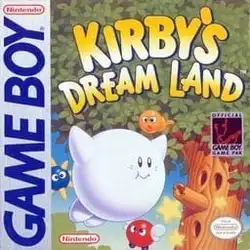
Kirby's Dream Land
Kirby's Dream Land is an action-platformer game developed by HAL Laboratory and published by Nintendo for the Game Boy in 1992.
Game Details:
As the inaugural game of the Kirby series, Kirby's Dream Land has a relatively simple premise and gameplay, designed to provide a friendly and accessible platforming experience for new players. The game's story revolves around Kirby's pursuit of King Dedede, a journey that spans just five stages. Kirby's core ability is to "Inhale": he can suck most enemies into his mouth and then choose to spit them out as star-shaped projectiles to attack other enemies or destroy obstacles. Additionally, Kirby can float—by inhaling air to inflate his body, he can fly indefinitely. This allows players to easily traverse dangerous platforms and chasms, significantly lowering the game's difficulty. Although this installment had not yet introduced the series' iconic "Copy Ability" mechanic, it did feature four special items: Fire, Microphone, Candy, and Mint Leaf, which Kirby could inhale to gain temporary special attack abilities. The game's art style is simple yet charming, and paired with its cheerful, lively music, it successfully established Kirby as an iconic character.
Game Guide:
As the first game in the series, Kirby's Dream Land has a low difficulty. The key to completing it is mastering the two basic abilities: Inhaling and Floating. Inhaling enemies and spitting them out as star projectiles is Kirby's primary method of attack. Players need to precisely control the timing and direction of these projectiles to hit enemies or destroy block obstacles in the stages. Since Kirby can float indefinitely, it's the safest way to navigate complex platforming sections. When facing difficult jumps or chasms, players should not hesitate to inhale and float to fly over them with ease, which greatly reduces the room for error.
Throughout the stages, be on the lookout for four temporary special items: Fire (lets you spit fireballs), Microphone (defeats all enemies on screen), Candy (grants temporary invincibility), and Mint Leaf (allows for rapid-fire star projectiles). Although the effects of these items are short-lived, they provide a huge advantage when facing numerous enemies or heading into a boss battle. The Microphone, in particular, is extremely efficient at clearing the screen of minor enemies. The game has only five main stages in total, and each boss has a set attack pattern. Players just need to observe their patterns and counterattack with inhaled star projectiles. For example, some bosses leave behind projectiles or debris after an attack that can be inhaled—this is the perfect time for the player to counterattack. For the final challenge, King Dedede, his attack pattern consists mainly of jumping and slamming. Players should take advantage of the openings when he lands to attack, or wait for him to inhale and spit out food, then inhale it and fire it back at him. Effectively using the float ability to dodge his ground slams is the key to defeating the final boss.
User Reviews
Action Related Retro Games
More
Platformer Related Retro Games
More


Cartoon Related Retro Games
More
Metal Slug 3
Arcade
Super Mario Bros.
NES / Famicom

Metal Slug 4
Arcade

Metal Slug X
Arcade
Super Mario World
SNES
Chip 'n Dale: Rescue Rangers
NES / Famicom
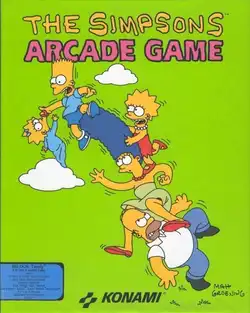
The Simpsons
Arcade

Inazuma Eleven
Nintendo DS

Knuckles Chaotix
Sega 32X
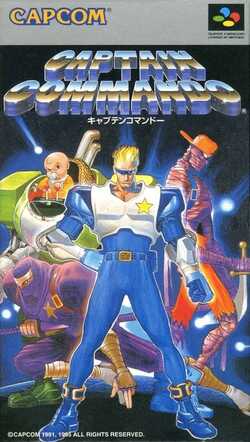
Great General
Arcade
The Lion King
SNES
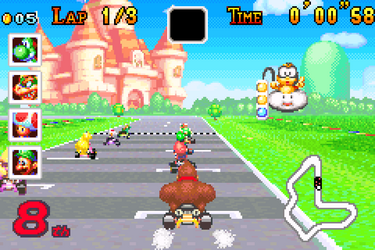
Mario Kart: Super Circuit
Game Boy Advance
Casual Related Retro Games
More
Snow Bros.
NES / Famicom
Bomberman
NES / Famicom
Rhythm Tengoku
Game Boy Advance
Super Mario Bros.
NES / Famicom
Galaxian
NES / Famicom
Super Mario World
SNES
Puzzle Bobble
Arcade
Hikaru no Go
Game Boy Advance
Pac-Man
Arcade
Chip 'n Dale: Rescue Rangers
NES / Famicom
Chinese Chess
NES / Famicom
Mario Kart: Super Circuit
Game Boy Advance