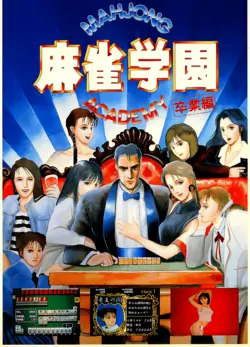
Game Details:
This title adopts classic Japanese two-player mahjong rules, eliminating the complex four-player dynamic for an extremely fast-paced experience. Players must draw and discard tiles to complete specific winning hands (yaku). As it's a one-on-one mode, actions like Riichi, Chii, Pon, and Kan occur much more frequently. The game boasts a distinctive audio-visual style, with exquisite character portraits and extensive voice acting. Beyond standard competitive play, the game introduces an "Item System" and a "Point Exchange" mechanism. Players can use their winnings to purchase special abilities (like seeing an opponent's hand, swapping tiles, etc.), significantly boosting the game's entertainment value and comeback potential.
Game Guide:
To succeed in "Mahjong Academy," you must first master the core logic of two-player mahjong. With only one opponent, the wall depletes very quickly, making the probability of winning after declaring Riichi far higher than in the four-player version. It's recommended to prioritize arranging your hand at the start of a round, aiming to build a foundation for Tanyao (All Simples) or Pinfu to reach tenpai quickly.
Using items strategically is the key to victory. Throughout the game, you'll acquire various "cheat" items, such as one that lets you "Swap all tiles in hand" or another that "Reveals your next draw." Be sure not to waste these items early on. Instead, save them for critical moments, like when your opponent reaches tenpai or when you're deadlocked (for example, being one tile away from a Yakuman). In particular, when the AI shows a strong desire to win (e.g., by frequently calling Pon), using a disruption-type item can effectively break its rhythm.
Additionally, calculating your hand's value (han) and managing your points are crucial. In the later stages of a match, if you have a point lead, adopt a defensive posture. Prioritize discarding safe tiles (those your opponent has already discarded) to prevent them from staging a comeback with a Yakuman. If you're behind, you need to play boldly and aim for high-scoring hands like Chin'itsu (Full Flush) or Chiitoitsu (Seven Pairs). Pay close attention to your opponent's discard patterns to deduce which tiles they need, allowing you to strategically block their hand.
User Reviews
Arcade Related Retro Games
More
Board Related Retro Games
More
Hikaru no Go
Game Boy Advance
Chinese Chess
NES / Famicom
Othello
NES / Famicom
Empire of Angels 2
MS-DOS
Gomoku Narabe
NES / Famicom
Shanghai: Mahjong Solitaire
MS-DOS
Romance of the Three Kingdoms: Heroes Biography
NES / Famicom
Romance of Sui and Tang Dynasties
NES / Famicom
Advance Wars
Game Boy Advance
Taiwan 16 Mahjong II: Horoscope Girls Edition
SNES
Hayauchi Super Igo
NES / Famicom
Casual Related Retro Games
More
Snow Bros.
NES / Famicom
Bomberman
NES / Famicom
Rhythm Tengoku
Game Boy Advance
Super Mario Bros.
NES / Famicom
Galaxian
NES / Famicom
Super Mario World
SNES
Puzzle Bobble
Arcade
Hikaru no Go
Game Boy Advance
Pac-Man
Arcade
Chip 'n Dale: Rescue Rangers
NES / Famicom
Chinese Chess
NES / Famicom
Mario Kart: Super Circuit
Game Boy Advance